From the emergence of nonlinear science and pioneering computational research to today’s broad interdisciplinary mission, CNLS has helped shape scientific discovery at Los Alamos since 1980.
This series offers a quick, personal glimpse into the lives of CNLS postdoctoral researchers. In a lightning-round format, participants discuss their research journeys, professional challenges, and advice for scientists following similar paths.
Four decades of nonlinear and interdisciplinary science
1954–1980
Scientific roots and the founding of CNLS
Original list of participants in the first meeting of the “Unstable Working
Group” held on December 3, 1978 and chaired by Campbell.
The Center for Nonlinear Studies was formally created in 1980 in response to the rapid emergence of solitons, dynamical systems, chaos, and other forms of collective nonlinear behavior. Its intellectual roots reach back to the 1954 Fermi–Pasta–Ulam–Tsingou simulations on the MANIAC computer, which unexpectedly showed recurrence rather than straightforward equipartition in a nonlinear lattice.
In the 1970s, Mitchell Feigenbaum built on a Los Alamos tradition that included Stan Ulam, Nick Metropolis, and Paul Stein to identify universal scaling in period-doubling transitions. Experiments soon confirmed that this universality appeared in real physical systems, helping transform nonlinear dynamics from an abstract mathematical subject into a broad scientific program.
A key institutional precursor was the 1978 “Unstable Working Group,” chaired by David Campbell and involving Feigenbaum, Alan Bishop, Basil Nicolaenko, Mac Hyman, Darryl Holm, Nick Metropolis, and other theorists. Campbell, Bishop, Nicolaenko, Hyman, and Holm developed the interdisciplinary concept that became CNLS, with Campbell and Nicolaenko sharing the first administrative responsibilities.
Scientific significance
The Fermi–Pasta–Ulam problem revealed that nonlinear many-body systems need not relax toward simple statistical equipartition, while Feigenbaum’s constants showed that very different dynamical systems can share the same route to chaos. Together, these ideas helped define nonlinear science as a field concerned with universality, emergence, and collective behavior.
Nonlinear latticesChaosUniversalityDynamical systems
1981–1985
The first director, founding members, and postdoctoral program
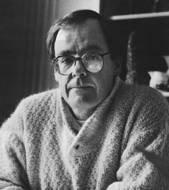
Alwyn Scott served as the first CNLS Director from 1981 to 1985.
Alwyn Scott, whose research focused on biological solitons, became the first CNLS Director. Founding members included Alan Bishop, David Campbell, Darryl Holm, Mac Hyman, and Basil Nichols. The first External Advisory Committee was appointed in 1981, with Mark Kac as chair.
A strong postdoctoral program was central from the beginning. Erica Jen became the first CNLS postdoctoral fellow in 1981, followed later that year by Doyne Farmer, who became the first CNLS J. Robert Oppenheimer Fellow. Other early fellows included Robert Ecke, Peter Lomdahl, David Brown, and Ioannis Kevrekidis.
Research during these formative years ranged from solitons and nonlinear waves to pattern formation, statistical mechanics, cellular automata, and biological dynamics. Early work included solitons in biological systems and conducting polymers, fractal dimensions of chaotic attractors, nonlinear stability of fluids and plasmas, and the Kuramoto–Sivashinsky equation as a bridge between partial differential equations and dynamical systems.
The Center’s structure deliberately brought mathematicians, physicists, computational scientists, and researchers from emerging application areas into sustained contact. Shared postdoctoral appointments, long-term visitors, conferences, and co-location became enduring features of the CNLS model.
Conferences as scientific catalysts
The 1982 conference Order in Chaos assembled many of the field’s leading figures. Evolution, Games, and Learning in 1985 connected adaptation, biological evolution, game theory, and machine learning, while the 1987–1988 Artificial Life meetings helped establish a field that continues internationally today.
1980s–1990s
A pioneer in scientific computing
Because much of CNLS research was computational, the Center became an early Laboratory pioneer in UNIX workstations and networking. Researchers described this emerging style as “experimental mathematics”: numerical simulation was not merely a supporting tool, but a way to discover structures, test conjectures, and connect mathematical models to experiments.
CNLS researchers helped develop lattice-gas hydrodynamics and its evolution into lattice-Boltzmann methods, while Shiyi Chen and collaborators implemented advanced fluid algorithms on the Thinking Machines CM-2 and CM-5 and carried out world-leading simulations of three-dimensional turbulence.
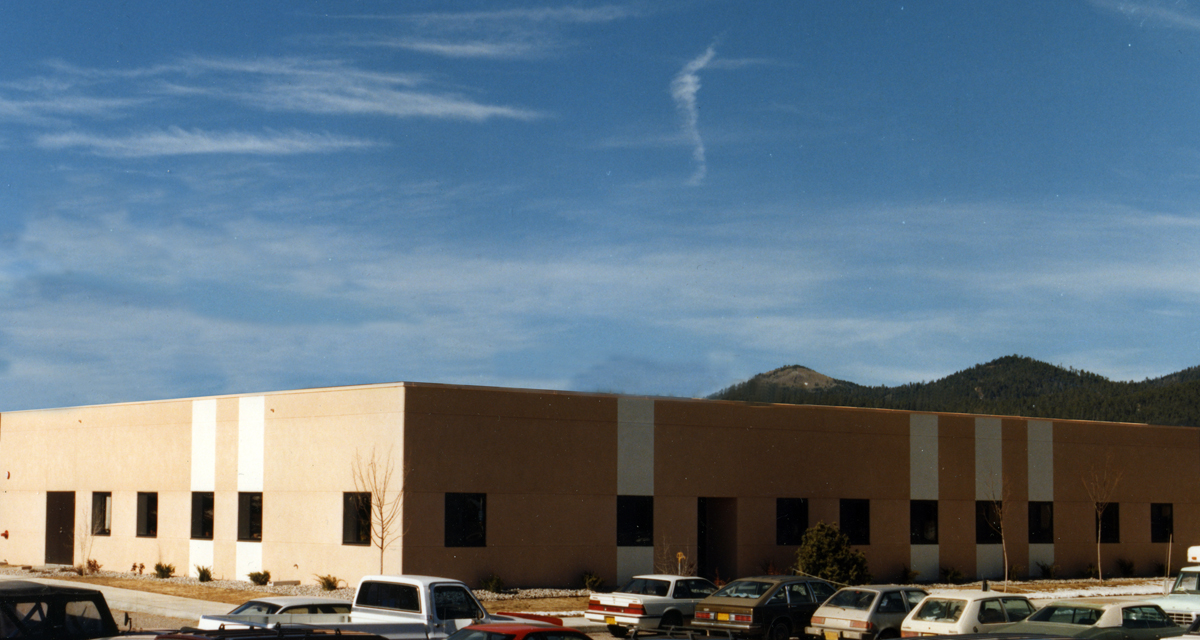
In 1989, CNLS moved into a dedicated building with a computer machine room and direct ties to the Advanced Computing Laboratory. CNLS continued to advance new computing concepts, including the design and construction of the Avalon Beowulf UNIX cluster in 1998. Its technical computing capability has remained an important Laboratory resource for postdoctoral researchers, affiliates, visitors, and students.
Computing as a scientific instrument
CNLS researchers used emerging parallel architectures to study turbulence, nonlinear wave propagation, lattice-gas models, complex networks, and high-dimensional dynamical systems. The Center helped establish a culture in which algorithms, software, and computing platforms were treated as integral parts of scientific discovery.
1985–1993
The David Campbell era
David Campbell became CNLS Director in 1985.
David Campbell became Director in 1985 and guided a rapid expansion of the Center. CNLS established an Executive Committee, and in 1987 Gary Doolen became the first permanent Deputy Director. Around the same time, the Theoretical Division formed a new Complex Systems Group led by former CNLS postdoc Doyne Farmer.
CNLS also created the Ulam Scholar position to attract exceptional scientists for extended visits. The first Ulam Scholar, appointed in 1985, was Oxford applied mathematician James Murray, noted for his work in mathematical biology and morphogenesis.
Campbell articulated four broad paradigms of nonlinear science: solitons and coherent structures; deterministic chaos and fractals; complex configurations and pattern formation; and adaptive nonlinear systems. These themes gave coherence to a field whose methods crossed conventional disciplinary boundaries.
The period also produced influential work on compactons, nonlinear waves with finite support; early neural-network control of a negative-ion accelerator; reaction–diffusion pattern formation; and rotating Rayleigh–Bénard convection, where wall modes and symmetry breaking linked experiment, theory, and computation.
The science also connected directly to Laboratory problems. CNLS researchers contributed to conducting polymers and synthetic metals, speech recognition, neural-network methods, porous-media flow using lattice-gas algorithms, and other applications where nonlinear interactions generated collective behavior across scales.
Pattern formationCoherent structuresNeural networksPorous media
1993–1997
Transition and continuity
Following Campbell’s departure in 1993, Deputy Director Gary Doolen served as Acting Director, supported by temporary deputies including Robert Ecke, Erica Jen, and Ronnie Mainieri. Don Cohen joined as Director in 1996 and, although his tenure was brief, left an important legacy by recruiting former CNLS postdoc Charlie Doering as Deputy Director.
1997–2003
Hans Frauenfelder and the rise of complex biological systems
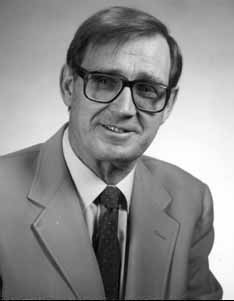
Hans Frauenfelder broadened CNLS toward complex systems and biological physics.
Hans Frauenfelder became the fourth CNLS Director in 1997. His scientific stature and broad view of nonlinear science as the study of complex systems brought stability and helped expand CNLS activity toward biological physics.
Shiyi Chen, a former CNLS postdoc and Oppenheimer Fellow, became Deputy Director and renewed the Center’s emphasis on hydrodynamics. His large-scale turbulence calculation on the Los Alamos CM-5 was among the largest of its kind and remained a benchmark for nearly a decade. During this period, CNLS attracted an exceptional group of postdoctoral fellows, including Misha Chertkov, Matthew Hastings, Charles Reichhardt, Sergei Tretiak, and Zoltan Toroczkai.
Frauenfelder’s leadership strengthened biological physics, particularly the use of energy landscapes, fluctuations, solvent coupling, and conformational dynamics to understand how proteins and other complex biomolecules function. The 1997 conference on landscape paradigms connected ideas from spin glasses and statistical physics with protein folding and biological function.
This era also produced landmark work in mathematical physics and computation, including the Camassa–Holm equation and its peaked solitons, non-Hermitian quantum mechanics with parity–time symmetry, climate and sea-ice modeling, and the Avalon commodity Linux cluster, which demonstrated that comparatively inexpensive hardware could deliver supercomputer-class performance.
Len Margolin became Deputy Director in 2000, followed later by Pieter Swart in an acting role. Frauenfelder returned to research in 2003 after seven years as Director.
1990s–2000s
Scientific growth and influential conferences
CNLS sustained high scientific activity with strong connections to Laboratory applications. Research contributed to plutonium–titanium safety questions, accelerator transmutation of waste, prediction and quantification of uncertainty, soliton-based descriptions of optical-fiber transmission, and the development of advanced parallel-computing platforms.
Soft matter became an especially productive meeting ground for statistical physics, materials science, biology, and fluid dynamics. The 2001 CNLS Annual Conference on Principles of Soft Matter, organized by David Egolf, Eli Ben-Naim, and Robert Ecke, drew more than 300 participants.
Network science then emerged as another major cross-disciplinary theme. The conference Networks: Structure, Dynamics, and Function attracted more than 350 attendees and helped accelerate research on the organization, robustness, and dynamics of systems ranging from infrastructure and communication networks to biological and social systems.
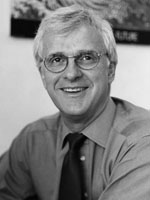
Robert Ecke led CNLS from 2004 to 2015, revitalizing its research portfolio and interdisciplinary programs.
Robert Ecke became the fifth CNLS Director, first in an acting role in 2004 and then permanently in 2005. Together with Deputy Director Zoltan Toroczkai, he revitalized the Center through new projects in networks and soft matter, a three-year project rotation, and renewed engagement with Laboratory technical staff.
These projects treated nonequilibrium materials, collective dynamics, and networked systems as connected scientific problems. Biological complexity was added as a major thrust, bringing together modeling, data, and statistical-mechanical ideas to study multiscale organization in living systems.
CNLS also sustained and rebuilt major Laboratory capabilities in quantum science. Work supported through the Center included quantum communication and capacity, topological quantum order, quantum magnetism, electronic-structure theory, and perovskite materials for photovoltaics. A Distinguished Quantum Lecture series brought internationally recognized leaders to Los Alamos.
Several long-term initiatives grew from the CNLS model of workshops, shared postdocs, and sustained program development. These included smart-grid science and risk-aware control of electrical networks; the q-bio school and conference in quantitative biology; physics-informed machine learning; and computer-vision research that contributed to the formation of Descartes Labs. Earlier CNLS connections also played a role in the scientific path that led to Ultra Safe Nuclear Corporation.
William Hlavacek served as Acting Deputy Director in 2007 and helped establish a biological complexity project. Eddy Timmermans became Deputy Director in 2008, followed by Mike Wall in an acting role in 2010 and Aric Hagberg in 2012.
Angel Garcia and a broader interdisciplinary portfolio
Angel Garcia served as CNLS Director from 2016 to 2022 and broadened its interdisciplinary theory and simulation portfolio.
Angel E. Garcia served as CNLS Director from 2016 to 2022, with Enrique Batista beginning his service as Deputy Director in 2016. During this period, CNLS continued to broaden its role in interdisciplinary theory and simulation while retaining the institutional practices that had sustained it for decades: shared postdoctoral fellows, intensive visitor engagement, topical workshops, and close partnerships with Laboratory groups.
The Center supported research across biological physics, materials and molecular simulation, quantum science, information science, machine learning, and systems far from equilibrium. The scientific emphasis increasingly reflected “complexity” in a broad sense: many-body interactions, multiscale dynamics, high-dimensional data, and the emergence of collective behavior in physical, biological, and engineered systems.
2022–present
Chris Fryer becomes CNLS Director
Chris Fryer became CNLS Director in 2022, continuing its tradition of fundamental and mission-relevant science.
Chris Fryer became CNLS Director in 2022, succeeding Angel Garcia. Fryer is an astrophysicist whose work spans stellar evolution, supernovae, compact-object mergers, nucleosynthesis, radiation transport, and high-performance multiphysics simulation. His arrival continued the CNLS tradition of leadership grounded in both fundamental science and mission-relevant computation.
With Fryer as Director and Enrique Batista as Deputy Director, CNLS continues to connect emerging external science with Los Alamos priorities. Its portfolio spans materials, quantum systems, biological and chemical physics, astrophysics, applied mathematics, information science, machine learning, complex networks, and dynamics far from equilibrium.
Across these areas, CNLS researchers develop mathematical theory, numerical algorithms, data-driven methods, and high-performance simulations to connect microscopic mechanisms with emergent behavior. Applications include quantum materials, turbulent and reactive flows, resilient infrastructure, extreme environments, molecular and biological dynamics, and uncertainty-aware prediction.
A professional support team serves postdoctoral associates, students, visitors, and technical staff, while specialized computing support sustains the collaborative environment that has been central to CNLS since its founding.
An enduring institutional model
CNLS remains distinctive because it has no large permanent scientific staff competing with Laboratory groups. Instead, it builds capability through shared postdocs, visitors, conferences, co-location, and program development, allowing ideas and resources to flow back into the broader Laboratory.