Casimir Interactions


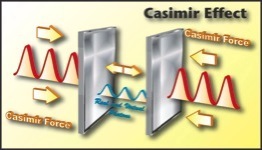

The Casimir force is an attractive force and the Casimir energy a binding energy. It is interesting to note that in this ideal case of perfectly reflective mirrors, the expressions of the force and energy depend only on geometrical parameters and two fundamental constants: the speed of the light and Planck's constant , the latter clearly showing the quantum character of the Casimir effect. These expressions are independent of atomic constants in contrast to Van der Waals forces. This universality property of the Casimir force and energy between two perfectly reflecting mirrors corresponds, as shown by Lifshitz, to the saturation of the mirrors response which cannot reflect more than 100% of the incident field.
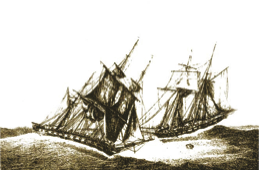
Although the Casimir oreffect is deeply rooted in quantum field theory, there are analogous effects in classical physics. A striking example is discussed in 1836 by P.C. Caussee in his L'Album du Marin (see figure). Caussee there reports a mysteriously strong attractive force that can arise between two ships floating side by side - a force that can lead to disastrous consequences. A physical explanation of this force was recently offered by Boersma who suggested that it has its origin in a pressure difference exerted by the sea waves between the ships and aroundthem.
The Casimir force is comparably small: for two mirrors with a surface of one cm2, separated by a distance of 10-6m, it equals 10-7 N. Nevertheless, it was observed experimentally, shortly after its theoretical prediction. Recently, it has been remeasured with modern experimental techniques; several experiments reached an accuracy in the % range by measuring the force between a plane and a sphere or two cylinders using either torsion-pendula or atomic force microscopes. Similar experiments were also performed with Micro-Electro-MechanicalSystems (MEMS). MEMS are tiny devices containing metallic elements on a micron and submicron scale. They have very promising performances and are already being used as pressure sensors in air-bags.
Francesco Intravaia Jun 30, 2010



